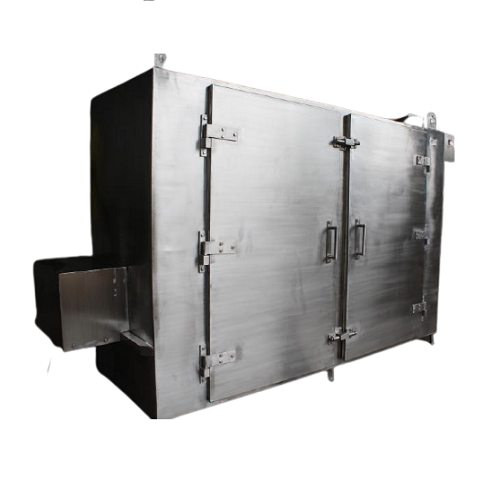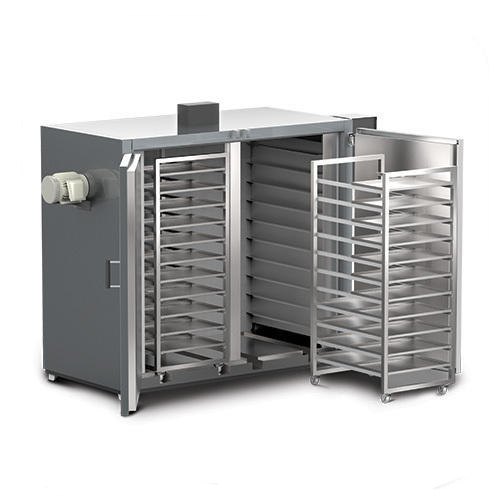
CoralPT Hot Air Tray Dryer is a GMP-oriented convective drying system engineered for controlled and uniform drying of pharmaceutical, API, bulk drug, nutraceutical and specialty chemical products. Available from compact 4-tray and 6-tray laboratory models up to 192-tray production systems, the dryer can be configured in SS304, SS316/SS316L or application-specific corrosion-resistant construction with electric, steam or other suitable heating arrangements.
The CoralPT Hot Air Tray Dryer uses controlled recirculation of heated air across product-loaded trays to remove moisture efficiently while maintaining repeatable process conditions. It is suitable for drying wet granules, powders, crystals, intermediates, excipients, herbal/nutraceutical materials and compatible chemical products where atmospheric hot-air drying is appropriate. The system can be supplied in standard, GMP or customized execution with single-skin or insulated double-skin construction, filtered air inlet, adjustable fresh-air/exhaust arrangement, temperature control, process timer, safety interlocks and trolley-based loading for larger capacities. For higher hygiene and air-quality requirements, selected models from 12 trays upward can be engineered with a dedicated air handling unit (AHU) and staged filtration/HEPA filtration subject to process and facility requirements.
Send Inquiry
A Hot Air Tray Dryer is a batch drying system in which product is spread in shallow trays and exposed to a controlled stream of heated air. CoralPT designs the equipment around the product, batch size, required final moisture, permissible product temperature, solvent/water load, heating utility, area classification and the user's GMP requirements. The objective is not simply to heat the chamber; it is to establish a stable drying environment with effective air distribution across the loaded tray area, controlled heat input and practical loading/unloading.
Fresh air is admitted through an inlet filtration arrangement and mixed with recirculated process air as required. The air is heated by the selected heating source and circulated through the drying chamber by a suitably selected blower/fan system. Heated air passes over and around the material spread in trays, absorbs evaporated moisture and is partly exhausted while the balance can be recirculated. Temperature is monitored and controlled to the configured set point. Airflow pattern, recirculation ratio, exhaust setting, tray loading depth and product characteristics collectively determine drying performance; therefore final airflow, blower capacity and heater duty are selected model-wise and process-wise rather than treated as one fixed value for every dryer.
The equipment is intended for atmospheric hot-air drying duties in pharmaceutical formulation, API and bulk drug manufacturing where the product is compatible with convective drying. Typical duties include drying of wet granules before downstream processing, powders, crystalline intermediates, excipients, compatible herbal/nutraceutical materials and non-sterile process materials. For potent, solvent-bearing, oxygen-sensitive, highly temperature-sensitive or containment-critical products, the process must be evaluated separately; a vacuum dryer, closed-loop/solvent-recovery system or another drying technology may be more appropriate.
For chemical, fine chemical and specialty chemical service, the dryer can be customized to the corrosion, temperature and area-classification requirements of the process. SS304 or SS316/SS316L may be selected for compatible products. Where stronger corrosion resistance is required, higher alloys such as Hastelloy can be evaluated based on the actual chemical composition, concentration, temperature and contaminants. Material selection must be confirmed from process corrosion data rather than selected only from a generic industry label.
For pharmaceutical applications, CoralPT can engineer smooth product-zone surfaces, cleanable internal geometry, stainless-steel trays/racks or trolleys, insulated double-skin body construction, appropriate door sealing, controlled inlet and exhaust air, instrumented temperature control and documentation suitable for project qualification requirements. The exact GMP scope, surface finish, material certificates, weld documentation and qualification package are defined in the approved URS and commercial offer.
Electric heating is suitable where electrical energy is preferred, rapid controllability is required or plant steam is unavailable. Steam heating can be used where suitable saturated steam is available and the required chamber/process temperature is compatible with the steam conditions and heat-exchanger approach. For duties requiring temperatures above the practical steam-heated operating envelope, electric heating or another engineered heating medium can be selected. Thermic-fluid or hot-water heating can also be evaluated for specific projects. Final heater duty is calculated against chamber size, airflow, heat losses, product moisture load, target temperature and heat-up requirement.
The standard air path can include an inlet filter and adjustable fresh-air/exhaust dampers. For pharmaceutical projects requiring enhanced control of incoming air quality, a separate AHU can be provided with staged filtration and, where required, terminal/high-efficiency filtration. CoralPT recommends the dedicated AHU option primarily from 12-tray capacity upward; 4-tray and 6-tray laboratory models are normally kept compact unless the URS specifically requires an external conditioned/filtered air system. Filter grade, HEPA requirement, pressure monitoring and air-change philosophy must be finalized against the process and facility classification.
Controls can range from a conventional electrical panel with temperature controller, timer, indications and protections to PLC-HMI based automation with recipe parameters, alarms, interlocks, batch timing, trend/data logging and communication interfaces. Flameproof/explosion-protected electrical execution can be engineered where the hazardous-area classification and applicable protection concept are clearly specified by the customer. Selection of flameproof components does not by itself make a process suitable for flammable-solvent drying; solvent loading, LEL risk, ventilation, earthing, static control and applicable safety standards require a dedicated process safety review.
|
Model |
Scale / Typical Use |
Tray Arrangement |
AHU Option |
Heating |
Engineering Note |
|
4 Tray |
Laboratory / R&D |
Compact fixed rack |
Normally not required |
Electric preferred; other utility options by URS |
Blower, heater and chamber size finalized for lab duty. |
|
6 Tray |
Laboratory / R&D / small pilot |
Compact fixed rack |
Normally not required |
Electric preferred; steam may be evaluated |
Compact configuration; low batch volume. |
|
12 Tray |
Pilot / small batch |
Fixed rack / engineered arrangement |
Available |
Electric / steam |
First standard size where a dedicated AHU can be practically integrated. |
|
24 Tray |
Pilot / production |
Rack or project-specific trolley |
Available |
Electric / steam / engineered utility |
Airflow and heater duty selected against product load. |
|
48 Tray |
Production |
Typically 1 trolley |
Available |
Electric / steam / engineered utility |
Common production configuration; trolley improves loading/unloading. |
|
96 Tray |
Production |
Typically 2 trolleys |
Available |
Electric / steam / engineered utility |
Multiple circulation sections/fans may be used for distribution. |
|
192 Tray |
High-capacity production |
Typically 4 trolleys |
Available |
Electric / steam / engineered utility |
Multi-zone airflow/heating philosophy may be engineered for uniformity. |
|
Material Option |
Typical Selection Logic |
Website Wording |
|
SS304 |
General-purpose stainless construction for compatible, non-aggressive products or non-contact/external surfaces. |
Available as project-specific construction where product compatibility permits. |
|
SS316 / SS316L |
Preferred for many pharmaceutical/product-contact applications requiring improved corrosion resistance and hygienic construction. |
SS316/SS316L product-contact construction available based on URS. |
|
Hastelloy / higher alloy |
For corrosive chemical service where stainless steel is not adequate; grade must be selected from actual chemistry and temperature. |
Hastelloy or other corrosion-resistant alloy can be evaluated for demanding chemical service after corrosion review. |
|
Parameter |
Recommended Website Entry |
|
Equipment |
Hot Air Tray Dryer / Air Tray Dryer |
|
Capacity |
4 / 6 / 12 / 24 / 48 / 96 / 192 trays; custom on request |
|
Process |
Batch convective drying by heated-air circulation |
|
Applications |
Pharmaceutical, API, bulk drug, nutraceutical and compatible chemical/specialty chemical products |
|
MOC |
SS304 / SS316 / SS316L / application-specific corrosion-resistant alloy |
|
Construction |
Standard / GMP-oriented; single-skin or insulated double-skin |
|
Heating |
Electric / steam; hot water or thermic fluid by project requirement |
|
Air Handling |
Recirculation with filtered fresh-air inlet and exhaust control; optional dedicated AHU |
|
Controls |
Temperature control + timer; optional PLC-HMI, recipes, logging and communication |
|
Area Classification |
Safe-area standard; flameproof/explosion-protected execution by approved hazardous-area requirement |
|
Documentation |
Project-specific FAT / DQ / IQ / OQ / MOC documentation as agreed |
FAQs (Frequently Asked Questions):
What is a Hot Air Tray Dryer used for?
It is used for batch drying of compatible powders, wet granules, crystals, intermediates, excipients and similar materials by controlled circulation of heated air across product loaded in trays.
Which Hot Air Tray Dryer capacities does CoralPT offer?
CoralPT's planned standard range covers 4, 6, 12, 24, 48, 96 and 192 trays, with custom configurations available against the process requirement.
Can the dryer be supplied in SS316L?
Yes. SS304, SS316/SS316L and application-specific higher-alloy construction can be engineered depending on product contact, corrosion resistance and GMP requirements.
What heating options are available?
Electric and steam heating are primary options. Hot-water, thermic-fluid or other engineered heating arrangements can be evaluated for project-specific requirements.
Can a Hot Air Tray Dryer be supplied with an AHU and HEPA filtration?
Yes. A dedicated AHU with staged filtration and HEPA filtration can be provided where required. CoralPT generally recommends this option from 12-tray capacity upward, subject to the URS and facility air-quality requirement.
Is flameproof construction available?
Flameproof/explosion-protected electrical execution can be supplied for appropriately classified areas. The complete drying process must still be reviewed for solvent load, ventilation, LEL, static and other process-safety requirements.
How is uniform drying achieved?
Drying uniformity depends on engineered airflow distribution, fan/blower selection, heat input, recirculation/exhaust setting, tray loading depth and product properties. These parameters are considered during model and process selection.
Is a tray dryer suitable for temperature-sensitive products?
It can be used when the product's permissible temperature and drying behavior are compatible with atmospheric convective drying. Highly heat-sensitive, oxygen-sensitive or solvent-sensitive products may require vacuum or another drying technology.
Does CoralPT provide qualification documents?
FAT and project-specific DQ/IQ/OQ, material certificates and supporting documentation can be included in the agreed project scope.
How do I select between 24, 48, 96 and 192 trays?
Selection should be based on batch mass, loading per tray, product bulk density, exposed drying area, initial/final moisture, target drying time, temperature limit, heating utility and production throughput - not tray count alone.